

Maintaining clean teeth is more than just brushing. Bristles of toothbrushes are unable to adequately clean all surfaces between the teeth where food particles get trapped. Hence, interdental cleaning is also essential for proper dental care.
This guide on water flosser vs floss does not focus on determining the best option but rather on understanding whether that particular method will work for your specific needs.
The conventional type of dental floss consists of a thin thread that is used to clean between the teeth and at the gum line. The floss helps in cleaning away any form of food particles or plaque from areas that the toothbrush cannot reach.
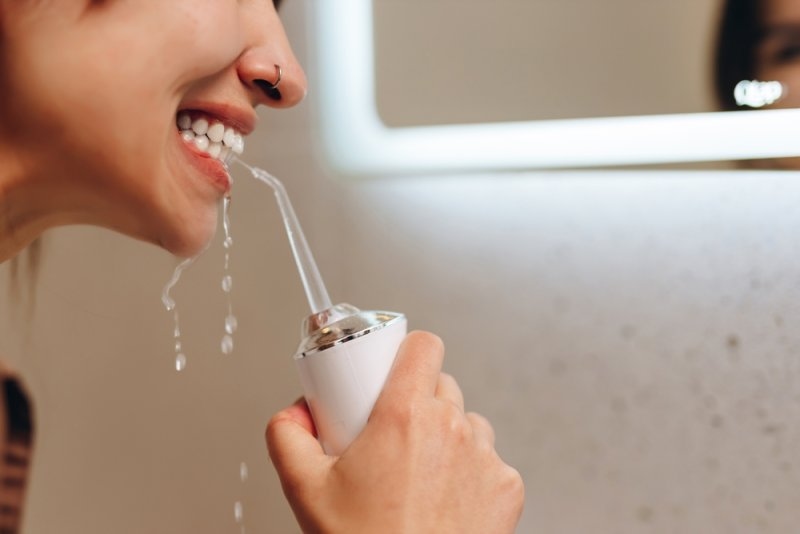
Water flossers are also known as oral irrigators and use a high-pressure stream of water to clean the mouth. They have the capability of removing any food particles or plaque between the teeth and at the gum line.
The only major difference between them is the way they operate.
When analyzing water flosser vs traditional floss, one must take into account other considerations apart from effectiveness.
Ease of use: It takes some effort to move the string between teeth using string floss, whereas in a water flosser, you need to fill up a tank, place the tip, and move water over the gum line.
Technique: Correct usage of both will ensure that you do not miss any area; otherwise, poor techniques will render both ineffective.
Comfort: Some people find the use of string floss uncomfortable to use. While others find it easy because of the direct contact with teeth. A water flosser is easy to use for those who have problems with their hands.
Convenience: String floss is cheap and easy to carry about. A water flosser entails the cost of the equipment and maintenance.
Accessibility: It is useful in cases involving braces and other dental work where string floss cannot reach easily.
Among the top advantages that have been associated with traditional dental floss is convenience. Flossing involves using a small packet of string that easily fits inside any travel or bathroom kit.
It is useful when cleaning between your teeth. By rubbing the floss along the sides of your teeth, it becomes possible to clear out the plaque in places where brushes cannot reach.
The ADA suggests cleaning the spaces between teeth using floss or any other tool of this kind on a daily basis. They also point out that the type of floss matters less than its proper usage.
The primary advantages of using a water flosser are convenience and accessibility for specific people. This device allows you to aim water streams between teeth, rather than flossing them one by one.
A water flosser is suitable for people with braces, orthodontic devices, bridges, crowns, implants, and any other dental treatment that makes it difficult to floss normally. Water flossers may be convenient for people who have problems with traditional floss.
There are some ADA-accepted powered interdental cleaners that have been proven effective in eliminating plaque and preventing and reducing gingivitis.
But a water flosser cannot replace regular brushing and dental treatment.
No one-size-fits-all solution exists.
If you manage to clean your teeth using the traditional flossing method and don’t have any difficulties with your gum tissue or your dental restoration, there might be no need for you to move to another method. Those who use dental floss properly do not need to shift to using a water flosser.
The water flosser is an efficient substitute in case you find it uncomfortable to use the traditional flossing technique. It does not matter which method is theoretically better. What really matters is whether you manage to clean between your teeth using it or not.
When choosing a water flosser for gum health, method and consistency will play a key role. Plaque around the gum line can cause gingivitis, which can lead to swelling or bleeding gums.
Water flossers can aid in removing plaque around the gum line and between teeth with proper use. Some powered interdental cleaners have received the ADA Seal of Acceptance due to the research supporting the removal of plaque and prevention of gingivitis.
Floss itself is capable of cleaning around the gum line when carefully placed in between and around the sides of the teeth. The point is not to try and push the floss into the gums but to clean around where the plaque resides.
If your gums tend to bleed, swell, hurt, or become irritated despite improving your regimen, you should speak with a dental professional rather than switching out products.
A water flosser for teeth is useful for those who have problems using traditional dental floss. It applies to those people who have difficulty manipulating floss due to limited hand mobility, braces, bridgework, or other types of dental restoration work.
The decision to use a water flosser or regular floss will depend on personal needs. Select conventional floss for those with close spacing of teeth, want something easy to use, and who have the dexterity to floss properly.
Select a water flosser for those with braces or other dental work, lack the dexterity to use floss, or prefer water flossing.
For regular dental flossing, slide the thread between your teeth, wrap it around each tooth, and move it on the surface of the teeth as well as the gum line without forcing it into your gums. Whichever method you choose to use, interdental cleaning is part of your brushing process. According to the ADA, brushing should be done twice a day and flossing once a day.
Also Read: Scaling and Root Planing Explained For Gum Disease Treatment
No need to make a water flosser vs floss competition because both devices can help maintain proper dental health when used right.
Traditional dental floss provides direct cleansing, simplicity, convenience, and ease of use in small gaps. In turn, the water flosser provides another option that can be easier to use by people with braces, dental work, problems with dexterity, or a preference for a water-cleaning option.
The best option is the one that you will use right and regularly. You can ask your dentist or dental hygienist which tool is more suitable for your teeth and gums.
Yes. Water flossing is one way to aid in removing plaque and other debris from between the teeth and gum line if done properly. Effectiveness varies based on the method and consistency of use and what spaces need to be cleaned.
In cases where there is crowding of the teeth and the contact points are very close to each other, regular floss is highly effective, as it is able to maneuver through those spaces and effectively clean the areas of the teeth.
Water flossing can be a substitute for traditional floss if you use it to clean between your teeth, but it does not mean that the cleaning process itself will not be necessary anymore. If you decide to use water flossing, be sure to include all the teeth and your gum line in the process. Follow the instructions for your device and set the proper pressure level.
Once per day is considered to be sufficient for the majority of people. The main thing is consistency. Choose the moment in your daily routine when you can easily include interdental cleaning in it.
Not all cases can be fixed by just changing products. Learn how to use dental floss properly and keep flossing regularly, but it is better to contact a dentist if there is any prolonged bleeding, pain, or even swelling.
This content was created by AI